




By John Paul
The loss of one of Nigeria’s two ATR-42-500 maritime patrol aircraft has reduced the Nigerian Air Force’s specialised crewed intelligence, surveillance and reconnaissance capacity, raising questions about fleet resilience, maintenance planning and the balance between manned aircraft and drones.
When the Nigerian Air Force’s ATR-42-500 aircraft, NAF 931, crashed in a swampy mangrove area near Igbokoda, Ondo State, on October 5, 2026, the immediate tragedy was the loss of 25 lives. But beyond the human cost, the accident removed one of the Service’s two dedicated ATR-42 maritime patrol aircraft, creating a significant gap in a specialised area of Nigeria’s airborne surveillance capability.
The aircraft was on a routine mission from Benin City, Edo State, to Lagos when air traffic controllers lost contact with it at approximately 9:13 a.m. local time. Its wreckage was subsequently located near a naval base at Igbokoda. The Nigerian Air Force later confirmed that all 25 people aboard, comprising 20 passengers and five crew members, had died.
The accident also generated confusion over the number of people aboard. Aviation Minister Festus Keyamo initially announced that preliminary information indicated 32 occupants, comprising 25 passengers and seven crew members. The NAF subsequently corrected the figure to 25. Authorities have not publicly explained the discrepancy.
While the investigation continues, the operational implications are becoming clearer. Nigeria has not lost all its airborne intelligence-gathering capacity, but the destruction of NAF 931 leaves the Service with only one of its two ATR-42 aircraft, potentially increasing pressure on its remaining surveillance platforms.
The central question is how effectively the NAF can maintain its surveillance missions while establishing what happened to the aircraft and ensuring that any lessons from the accident are applied across the fleet.
A specialised aircraft with a wider security role
The ATR-42-500 maritime patrol aircraft were acquired from Italian aerospace company Alenia Aeronautica under a contract signed in March 2007. The approximately $73 million agreement covered two aircraft, crew training and logistics support.
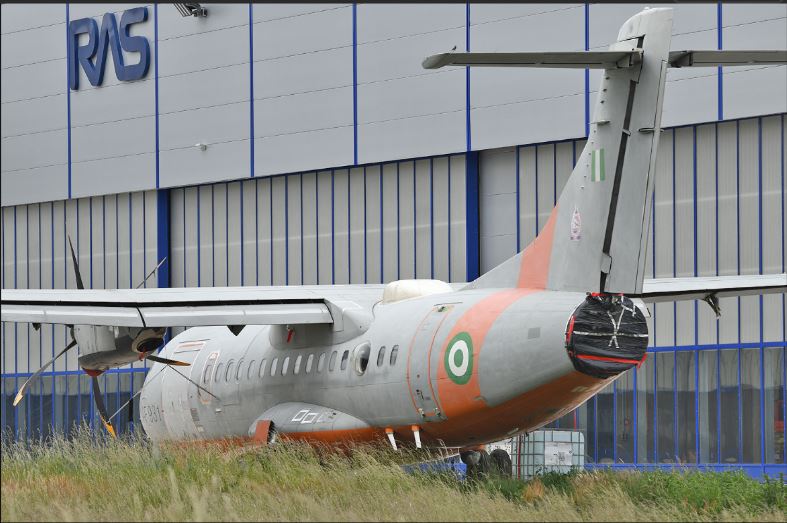
The first aircraft, NAF 930, arrived in Nigeria in December 2009, followed by NAF 931 in March 2010. Both were configured for maritime patrol and intelligence, surveillance and reconnaissance operations. They were operated by the NAF’s 81 Air Maritime Group in Benin City and could also support search-and-rescue and limited transport duties.
Their importance lies in the ability to gather information over large areas and help commanders understand what is happening on the ground or at sea.
In Nigeria’s maritime environment, airborne surveillance can support monitoring of suspicious vessel movements, illegal activities along the coast and threats to commercial shipping and offshore infrastructure. In other operational theatres, surveillance aircraft can help locate suspicious movements, track targets and provide information to units conducting security operations.
The ATR-42’s value is not limited to carrying sensors. Its onboard mission personnel can examine the information collected, assess its operational significance and communicate relevant intelligence to commanders. This can help turn raw observations into information that supports decisions.
The precise contribution of any aircraft depends on its equipment, mission profile, weather conditions and the availability of other intelligence sources. Nevertheless, removing one of only two dedicated platforms of this type reduces the number of aircraft available for the specialised tasks for which they were acquired.
The limits of replacing aircraft with drones
The loss of NAF 931 is likely to renew discussion about the role of unmanned aerial vehicles in Nigeria’s security architecture.
Drones have become increasingly important in contemporary military operations because they can provide persistent surveillance, monitor remote areas and, depending on their design, remain airborne for extended periods. They can be particularly useful for monitoring known insurgent routes, border areas and locations where prolonged observation is required.
Nigeria’s wider surveillance inventory includes other platforms, including Beechcraft King Air 350i aircraft and Wing Loong II unmanned aircraft, according to Unmanned Africa’s analysis of the country’s ISR capabilities. The loss of NAF 931 therefore does not mean that the country has been left without airborne surveillance.
However, drones and crewed surveillance aircraft should not automatically be treated as interchangeable.
A medium-altitude, long-endurance drone may offer extended time on station, but its practical usefulness depends on the sensors it carries, its communications links, its operating environment and the availability of trained personnel to exploit the information it gathers.
A larger crewed turboprop aircraft can accommodate mission personnel and substantial equipment, including radar and electro-optical sensors. Depending on its configuration, such an aircraft can support onboard processing and coordination without requiring every stage of the mission to depend on a remote operator.
The ATR-42’s reported configuration includes an ATOS mission system, search radar and EOST-45 electro-optical sensor, according to specialist reporting by Military Africa. These systems support the aircraft’s surveillance role, although their actual performance and availability at the time of the accident have not been established publicly.
For the NAF, the implication is that replacing the lost aircraft with drones alone may not fully reproduce its former capabilities. A more resilient approach would combine crewed surveillance aircraft, unmanned systems, ground-based intelligence and information from maritime and other security agencies.
Such a layered arrangement could allow one platform to compensate partially for the absence of another while ensuring that different systems contribute according to their strengths.
Maintenance history and the question of sustainability
The loss also brings the maintenance history of the ATR-42 fleet into sharper focus.
NAF 930 underwent major maintenance, repair and overhaul at Rheinland Air Service in Mönchengladbach, Germany, after accumulating approximately 5,000 flight hours. The aircraft left Nigeria for the maintenance programme in September 2019 and returned in July 2020. The Nigerian Air Force described the exercise as the first periodic depot maintenance conducted on the aircraft after about a decade of operation
The programme was intended to restore serviceability and sustain the aircraft’s operational capability. It also provided an opportunity for NAF engineers and technicians to develop experience working with the specialist maintenance facility.
The experience illustrates the complexity of sustaining specialised military aircraft. Maintaining a surveillance platform involves more than routine inspections of the airframe and engines. Its mission equipment, avionics, sensors and associated systems must also remain serviceable.
Where major maintenance requires overseas facilities, specialised expertise or imported components, the time an aircraft spends out of service can become an operational consideration. If one of only two aircraft is undergoing an extended maintenance programme, the remaining platform may have to shoulder a greater proportion of the fleet’s workload.
This does not establish that maintenance problems contributed to the crash of NAF 931. The aircraft’s age and its maintenance history cannot, on their own, explain why it went down.
Rather, the accident reinforces the need for a careful assessment of fleet availability, maintenance records, component life limits, technical support arrangements and the time required to return aircraft to service.
The investigation should establish whether any technical or maintenance factors contributed to the crash. Any broader review should be based on evidence rather than assumptions about the age of the aircraft.
The cost of losing an operational option
Military capability is often measured by the number of aircraft, helicopters or drones in an inventory. But the more important question is how many of those platforms are serviceable and available for specific missions when commanders need them.
The loss of NAF 931 reduces the NAF’s options for allocating crewed maritime patrol and surveillance missions. The extent of the resulting gap will depend on the condition and availability of NAF 930, the capacity of other surveillance aircraft and drones, and the competing demands placed on those systems.
If other platforms can absorb the displaced missions, the immediate effect may be manageable. If they are already heavily committed, however, the loss could require changes to surveillance schedules, mission priorities or deployment patterns.
That is why fleet resilience matters. A force that depends heavily on only one or two aircraft for a specialised task can become vulnerable when one platform is lost or grounded for maintenance.
The challenge is not simply to acquire replacements whenever an accident occurs. It is to establish a sustainable mix of platforms, spare parts, technical expertise and maintenance capacity that allows essential operations to continue when individual assets become unavailable.
This requires long-term planning. Acquisition decisions must consider not only the purchase price but also training, maintenance, sensor upgrades, spare parts and the cost of keeping the aircraft operational throughout its service life.
The investigation must deliver lessons
The NAF has established a 12-member Aircraft Accident Investigation Board to determine the circumstances and causes of the October 5 crash and recommend measures to prevent a recurrence. The Service has also urged the public not to speculate about the cause while the investigation is under way.
The board’s findings will be central to understanding the accident. Investigators will need to examine available flight records, maintenance documentation, wreckage evidence and other relevant technical information, while considering the operational circumstances surrounding the flight.
The discrepancy between the initial estimate of 32 occupants and the corrected manifest of 25 also deserves a clear administrative explanation. Although the difference does not establish anything about the cause of the crash, accurate passenger and crew records are essential to emergency response, casualty accounting and public communication.
Beyond the immediate investigation, the NAF should use the findings to determine whether additional safety measures or changes to maintenance and operating procedures are necessary. Any identified shortcomings should be addressed promptly, with appropriate oversight of the implementation of recommendations.
The process should also recognise the human dimension of the tragedy. The 25 people who died were not merely occupants of an aircraft; they were individuals whose deaths have affected families, colleagues and the wider military community. Support for bereaved families and accurate communication about the investigation must remain part of the Service’s response.
A test of the NAF’s long-term planning
The loss of NAF 931 presents the Nigerian Air Force with two connected responsibilities: to establish what caused the crash and to preserve the operational capabilities that remain.
The first requires a rigorous, evidence-based investigation. The second requires a realistic assessment of surveillance requirements, fleet availability and the sustainability of the aircraft and systems on which the Service depends.
The incident also offers an opportunity to review how crewed aircraft and unmanned systems can complement each other. Drones can provide endurance and persistent observation, while larger crewed platforms can offer payload capacity and onboard mission processing. A balanced architecture would use each capability where it is most effective rather than assume that one can entirely replace the other.
Ultimately, the significance of the ATR-42 loss will be determined not only by the aircraft’s absence from the NAF inventory but also by how the Service responds to the setback.
The priority must be to establish the facts, support the families of those who died, strengthen aviation safety and ensure that Nigeria retains reliable surveillance capacity across its maritime and internal security environments.
The loss of one aircraft cannot be reversed. But the operational lessons drawn from the tragedy can help the NAF build a more resilient fleet, improve its maintenance planning and reduce the risk of similar accidents in the future.