







By JohnPaul Amaechi
Nigeria’s fight against terrorism could be entering a new phase as Boko Haram and the Islamic State West Africa Province (ISWAP) reportedly turn to artificial intelligence (AI) to strengthen their operational capabilities, raising fresh concerns about the ability of security agencies to keep pace with rapidly evolving technology.
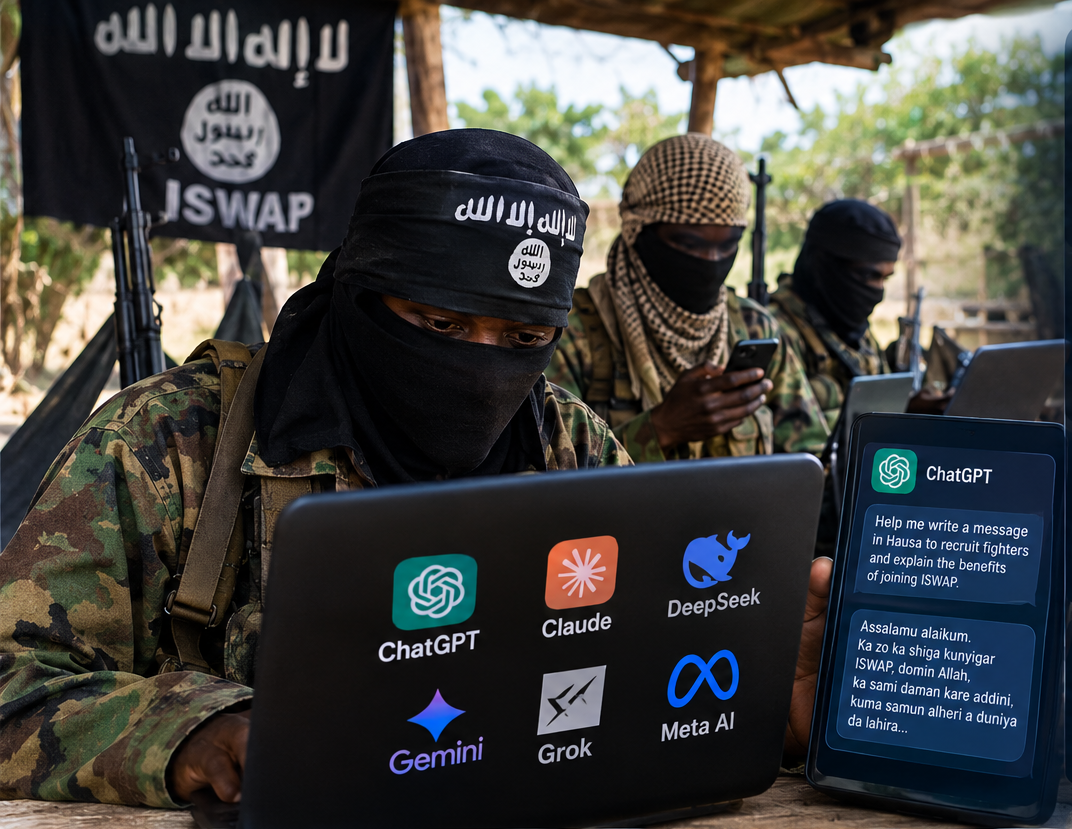
A study by researchers at the University of Cambridge has revealed that members of the two extremist organisations have used AI tools for technical guidance, attack planning and weapons-related activities, suggesting that the technology is becoming part of a broader effort to improve their capabilities.
The research, based on in-person interviews with dozens of former members of Boko Haram and ISWAP, points to a shift in how extremist organisations acquire and share technical knowledge.
Rather than relying exclusively on traditional training methods and experienced operatives, some members are reportedly turning to readily available AI platforms for information that could support their activities.
The development presents a new challenge for Nigerian security agencies, which have spent years confronting insurgent groups operating across the country’s North-East and the wider Lake Chad Basin.
Antonia Juelich, a technology and terrorism researcher at Cambridge University who authored the study, said AI use within the groups had become institutionalised through specialised units and internal training.
According to the researcher, the groups have reportedly used platforms including ChatGPT, Claude, DeepSeek, Gemini, Grok and Meta AI.
The findings suggest that the implications of AI for national security extend beyond the technology itself to the ability of violent organisations to integrate digital tools into their existing structures.
From traditional training to digital assistance
The reported use of AI by Boko Haram and ISWAP marks a potential change in how members obtain technical information.
Historically, extremist organisations have depended on experienced operatives, informal networks, specialised training and information exchanged among affiliated groups to develop their capabilities.
AI introduces another channel through which users can seek explanations, troubleshoot technical problems and obtain information on unfamiliar subjects.
According to Juelich’s research, ISWAP’s use of the technology was not limited to individual members experimenting with online tools. The study describes a system in which specialised personnel reportedly trained commanders and other members to use AI platforms.
The Islamic State group’s global leadership allegedly facilitated the process by sending instructors from Iraq, Afghanistan, North Africa and other regions to train ISWAP commanders.
The instructors reportedly supplied laptops with encryption software, established subscription accounts and provided guidance on using different platforms.
If sustained, such arrangements could enable extremist organisations to distribute technical knowledge more widely within their networks.
However, the research does not establish that every member of Boko Haram or ISWAP has access to AI or that all the groups’ operations depend on the technology.
Why the development matters for Nigeria
The central security concern is not necessarily that AI will enable extremist groups to invent entirely new weapons or tactics. Rather, it may help them improve activities they already understand.
Graig Klein, an international terrorism specialist at Leiden University in the Netherlands, said the Cambridge findings were consistent with research suggesting that AI was more likely to act as a force multiplier than to generate completely new forms of terrorism.
A force multiplier is a tool or capability that improves the effectiveness of existing resources.
For an organisation with years of experience in guerrilla warfare, the ability to access technical information more quickly could potentially reduce some barriers to learning and problem-solving.
Adonijah Ndege, a Nairobi-based reporter for TechCabal, similarly argued that the danger lies in established terrorist organisations becoming more effective at activities they already know how to perform.
For Nigeria, this raises questions about whether counterterrorism strategies are adapting quickly enough to technological developments.
Security operations have traditionally focused on intelligence gathering, surveillance, weapons recovery, the disruption of supply routes and the identification of militant networks. AI-assisted activities could complicate some of these efforts by expanding the channels through which members seek information and develop technical skills.
Nevertheless, the actual impact of AI on the frequency, sophistication or lethality of attacks remains a matter requiring further investigation.
A cross-border technological threat
The Cambridge study also raises concerns about the international spread of AI-related capabilities among extremist organisations.
Juelich estimated, based on her interviews, that ISWAP began using AI as early as 2023, only months after the launch of ChatGPT in November 2022.
She argued that the development was connected to a wider training programme promoted by the Islamic State’s global leadership.
Because the organisation operates through affiliated groups in different regions, Juelich warned that similar training could have reached other affiliates.
She also reported that Boko Haram received parallel training through separate networks, indicating that the reported adoption of AI was not confined to one group.
The findings point to the possibility that counterterrorism agencies may increasingly need to share intelligence on technological developments across national borders.
For Nigeria and its neighbours in the Lake Chad Basin, regional cooperation could become particularly important in monitoring how extremist groups acquire digital equipment, exchange technical knowledge and adapt to emerging technologies.
However, the study’s findings should not be interpreted as proof that all Islamic State affiliates are using AI in the same way. The scale and distribution of the reported practices remain uncertain.
Can technology companies close the gap?
Another major concern is whether AI developers can prevent their products from being exploited by violent extremist groups.
The study describes attempts by users to bypass safeguards built into AI platforms, including through a technique known as jailbreaking.
Such attempts are designed to circumvent restrictions intended to prevent AI systems from generating dangerous or harmful instructions.
The reported experience of Boko Haram and ISWAP members highlights the difficulty of relying exclusively on automated safeguards to prevent misuse.
Technology companies may need to continue improving their systems’ ability to recognise harmful requests, detect repeated attempts to evade restrictions and respond to emerging patterns of abuse.
At the same time, effective safeguards must account for the legitimate uses of AI in education, scientific research, journalism and other fields.
The challenge is therefore not simply to restrict access to AI but to reduce the risk that its capabilities can be exploited to facilitate violence.
Intelligence and prevention must evolve
For Nigerian security agencies, the reported use of AI reinforces the importance of adapting intelligence and counterterrorism approaches to the changing technological environment.
This could include strengthening digital intelligence capabilities, improving cooperation with technology companies where legally appropriate, and expanding information-sharing arrangements with regional and international partners.
Investigators may also need to consider whether digital tools played a role when examining terrorist communications, training materials and other evidence recovered during operations.
Any such measures would require appropriate legal safeguards and careful assessment to avoid treating ordinary AI use as evidence of terrorist activity.
Equally important is the need to establish the facts surrounding the reported practices. The Cambridge study offers insights from former members, but further independent research would help determine how widespread the use of AI is, which activities it materially improves and whether it has changed the outcomes of actual attacks.
The battle beyond the battlefield
The growing availability of AI means that the contest between extremist organisations and security agencies is no longer limited to weapons, personnel and territory. It increasingly includes the ability to acquire, interpret and apply information.
A former ISWAP member interviewed by Juelich captured the group’s reported confidence in the technology when he said: “There is nothing we haven’t received an answer on.”
The statement reflects the perception that AI can provide extensive technical assistance, although it does not establish that the systems are always accurate or capable of answering every question.
For Nigeria, the implications are significant. If terrorist groups can use AI to improve existing capabilities, security agencies will need to understand the technology’s role without overstating its effects.
The immediate task is to determine how the tools are being used, assess whether they have materially changed the groups’ operations and develop proportionate responses.
Ultimately, the emergence of AI-assisted terrorism will test not only the technical capacity of security agencies but also their ability to anticipate threats, cooperate across borders and translate intelligence into effective prevention.
The technology may not fundamentally change the nature of terrorism, but its reported adoption by Boko Haram and ISWAP suggests that the methods used to support extremist operations are evolving—and that Nigeria’s counterterrorism response must evolve with them.