




By PHIL JOHN
Healthcare is not a peripheral component of military effectiveness; it is an essential part of combat readiness, troop morale and force sustainability.
For the Nigerian Army, whose personnel operate in challenging environments across the country, the quality, availability and speed of medical care can determine not only whether a wounded soldier survives, but also how quickly personnel recover and return to duty.
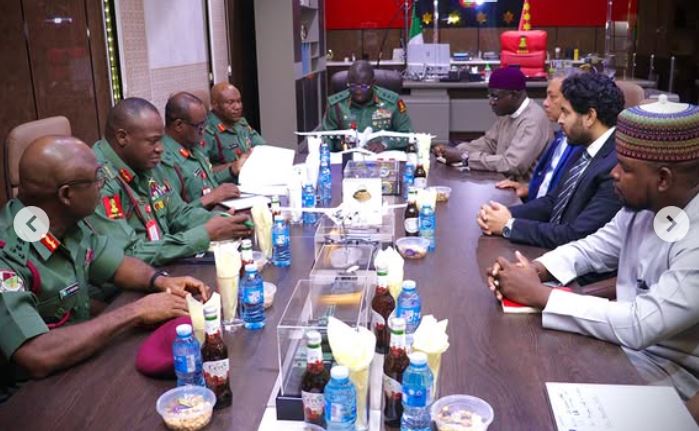
The recent emphasis by the Nigerian Army on strengthening healthcare infrastructure, including its engagement with private-sector partners, therefore deserves to be viewed as a strategic investment rather than simply a welfare initiative. On September 3, 2026, Chief of Army Staff, Lieutenant General Waidi Shaibu, discussed collaboration aimed at improving Army hospitals, medical equipment, pharmaceutical support and digital health services.
Healthcare as a component of operational readiness
Military healthcare has a unique responsibility. Unlike conventional civilian healthcare, it must function during peace, internal security operations, emergencies and armed conflict. Nigerian soldiers deployed against terrorism, banditry, insurgency and other security threats may operate far from major urban hospitals.
This makes the strength of the Army’s medical chain particularly important.
The Nigerian Army Medical Corps currently operates three reference hospitals, eight divisional hospitals and additional medical facilities across the country. At the divisional level, the system is structured around medical centres and regimental medical facilities that provide primary care, while more complicated cases are referred to higher-level hospitals.
The challenge is to ensure that this chain functions effectively from the battlefield to the specialist hospital.
A soldier injured during an operation should not have to face unnecessary delays because of inadequate ambulances, insufficient blood supplies, limited diagnostic equipment or a shortage of specialists. Every minute between injury and definitive treatment can matter.
Infrastructure must go beyond buildings
Constructing new hospitals is important, but infrastructure should not be measured simply by the number of buildings commissioned.
A modern military healthcare system requires functional operating theatres, intensive-care units, diagnostic imaging, laboratories, blood banks, pharmacies, rehabilitation facilities and reliable emergency transportation.
It also requires dependable electricity, water, communications and medical oxygen. In locations where the national power supply is unreliable, hospitals should increasingly incorporate solar power, backup generation and other resilient energy systems.
There are already examples of infrastructure investment within the military medical system. The Federal Ministry of Defence has highlighted the completion of a 100-bed accommodation facility for medical interns at the 44 Nigerian Army Reference Hospital in Kaduna, including an alternative solar power system.
Such investments demonstrate an important principle: healthcare infrastructure includes the environment in which medical professionals work and train, not merely patient wards.
The battlefield medical chain needs strengthening
Perhaps the most important area for investment is frontline medical support.
The Army should continue developing a seamless evacuation system linking:
field medic → regimental medical facility → brigade medical centre → divisional hospital → reference hospital → specialist civilian facility where necessary.
This requires adequately trained combat medical personnel, modern ambulances, trauma equipment, blood products, communications systems and clearly defined evacuation protocols.
Technology can also improve the system. Telemedicine could allow specialists at reference hospitals to support medical personnel in remote formations. Digital patient records could help doctors access relevant medical histories when soldiers are transferred between facilities.
The objective should be simple: the location of a soldier should not determine the quality of emergency care available to him or her.
Developing specialist medical capacity
Infrastructure without skilled personnel will produce buildings rather than healthcare.
Nigeria’s military medical system needs sustained investment in doctors, nurses, pharmacists, laboratory scientists, radiographers, physiotherapists, psychologists, biomedical engineers and other healthcare professionals.
The proposed Armed Forces College of Medicine and Health Sciences could become particularly important in this regard. The Federal Government said in February 2026 that the institution is being developed to address manpower shortages and expand medical training capacity, with clinical training linked to military hospitals including 68 Nigerian Army Reference Hospital.
This presents an opportunity to build a deliberate pipeline of military healthcare professionals who understand both clinical medicine and the peculiar demands of military operations.
Retention, however, will be just as important as training. Competitive remuneration, professional development, postgraduate opportunities, modern working environments and decent accommodation can help retain highly trained personnel.
Mental health should receive greater attention
The physical wounds of military service are visible. Psychological injuries are often less obvious.
Soldiers exposed to combat, terrorism, loss of colleagues and prolonged operational stress may require professional psychological and psychiatric support. Mental healthcare should therefore be integrated into routine military healthcare rather than treated as an afterthought.
Early intervention can help prevent operational stress from developing into more serious problems. Families of serving personnel should also have access to appropriate counselling and support.
A strong military healthcare system must therefore care for the whole soldier—physical, psychological and social.
Public-private partnerships can accelerate modernisation
The Army’s current exploration of partnerships with the private sector could provide an additional route to modernisation.
Private-sector participation could support the acquisition and maintenance of sophisticated equipment, specialist services, pharmaceutical supply chains, digital health systems and hospital management expertise.
But partnerships must be carefully structured.
The Nigerian Army should avoid arrangements that create dependency or make essential medical services vulnerable to commercial interests. Contracts should contain clear performance indicators, maintenance obligations, transparency provisions and mechanisms for monitoring value for money.
The partnership should strengthen military medical capacity—not replace it.
Reducing dependence on overseas treatment
Another important objective should be to reduce unnecessary medical referrals abroad.
The Defence Ministry has explicitly identified the strengthening of domestic military healthcare capacity as part of efforts to reduce medical tourism and improve self-reliance.
Nigeria already has considerable medical expertise. The challenge is to combine that expertise with modern equipment, specialist training, research capacity and properly managed institutions.
Money spent on overseas treatment can, in appropriate cases, be redirected into domestic specialist centres, training and equipment.
However, overseas referral should not be eliminated as an ideological objective. Where a treatment genuinely cannot be provided safely in Nigeria, personnel should receive the best available care. The long-term objective should instead be to progressively reduce avoidable referrals.
New facilities should follow operational needs
The commencement of a 120-bed Army Medical Centre at Depot Nigerian Army, Amasiri-Edda, in the South-East is an example of infrastructure being linked to operational requirements. The facility is expected to improve access to emergency treatment, specialist care and rehabilitation while supporting military operations in the region.
Future projects should similarly be guided by data.
Before constructing a facility, the Army should assess troop population, geographical coverage, casualty patterns, disease burden, operational deployments, referral times and existing capacity.
The question should not simply be “Where can we build another hospital?”
It should be “Where is the medical gap greatest, and what facility will close it most effectively?”
Accountability and maintenance are critical
One of the weaknesses of infrastructure development in many sectors is the tendency to celebrate commissioning while neglecting maintenance.
A modern CT scanner that becomes unusable because there is no maintenance contract is not an investment; it is an expensive liability.
Every major military medical project should therefore include a lifecycle plan covering equipment maintenance, spare parts, software upgrades, staffing, power supply, consumables and periodic refurbishment.
Performance should also be measured through indicators such as emergency response time, patient outcomes, equipment availability, referral time, hospital-acquired infections, drug availability and patient satisfaction.
A strategic opportunity for the Nigerian Army
Strengthening Army healthcare provides an opportunity to achieve three objectives simultaneously: protect soldiers, improve operational readiness and build national medical capacity.
The Nigerian Army Medical Corps has an established network and institutional experience. What is now required is sustained modernisation, stronger specialist capacity, better frontline evacuation, digital integration, reliable infrastructure and effective partnerships.
The ultimate test should not be the number of hospitals opened or equipment purchased. It should be whether a soldier who becomes sick or wounded receives timely, competent and dignified treatment regardless of where he or she is deployed.
For an Army operating in a complex security environment, healthcare is ultimately a matter of national security. A force that can rapidly treat, rehabilitate and return its personnel to health is a force better prepared to defend the nation.
Strengthening healthcare delivery and infrastructure should therefore be regarded as an investment in the Nigerian Army’s fighting strength—not merely an investment in hospitals.